// shelf 2023
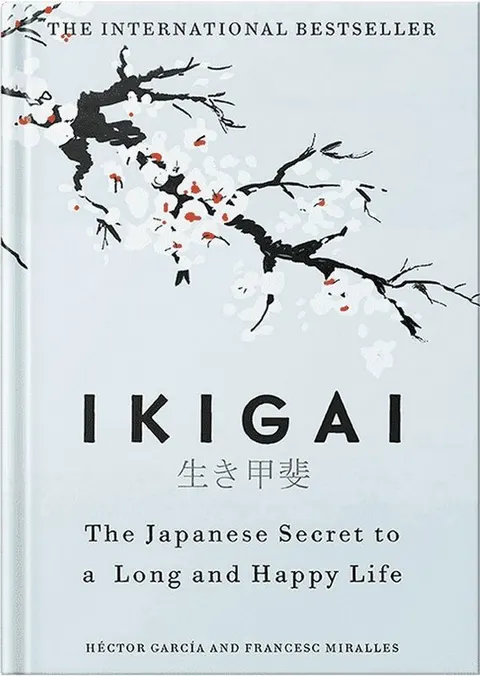
Ikigai
Hector Garcia
65 highlights read dec 2023 find this book ↗
Passages
17 of 65, in reading order
-
loc. 42
Only staying active will make you want to live a hundred years.
-
loc. 92
Rather than harbor animosity toward outsiders, however, Okinawans live by the principle of ichariba chode, a local expression that means “treat everyone like a brother, even if you’ve never met them before.”
-
loc. 128
In Japanese, ikigai is written as 生き甲斐, combining 生き, which means “life,” with 甲斐, which means “to be worthwhile.” 甲斐 can be broken down into the characters 甲, which means “armor,” “number one,” and “to be the first” (to head into battle, taking initiative as a leader), and 斐, which means “beautiful” or “elegant.”
-
loc. 190
Imagine a sign far off in the future with a number on it that represents the age of your death. Every year that you live, you advance closer to the sign. When you reach the sign, you die. Now imagine a rabbit holding the sign and walking to the future. Every year that you live, the rabbit is half a year as far away. After a while, you will reach the rabbit and die. But what if the rabbit could walk at a pace of one year for every year of your life? You would never be able to catch the rabbit, and therefore you would never die. The speed at which the rabbit walks to the future is our technology. The more we advance technology and knowledge of our bodies, the faster we can make the rabbit walk. Aging’s escape velocity is the moment at which the rabbit walks at a pace of one year per year or faster, and we become immortal.
-
loc. 252
High doses of cortisol and adrenaline at moments of danger kept the body healthy. Low doses of cortisol flow constantly through the body, with implications for a range of health problems, including adrenal fatigue and chronic fatigue syndrome.
-
loc. 274 ❦
After observing a group of test subjects for more than twenty years, Dr. Howard S. Friedman, a psychology professor at the University of California, Riverside, discovered that people who maintained a low level of stress, who faced challenges and put their heart and soul into their work in order to succeed, lived longer than those who chose a more relaxed lifestyle and retired earlier. From this, he concluded that a small dose of stress is a positive thing, as those who live with low levels of stress tend to develop healthier habits, smoke less, and drink less alcohol.
-
loc. 396
Based on his own experience, Frankl believed that our health depends on that natural tension that comes from comparing what we’ve accomplished so far with what we’d like to achieve in the future. What we need, then, is not a peaceful existence, but a challenge we can strive to meet by applying all the skills at our disposal. Existential crisis, on the other hand, is typical of modern societies in which people do what they are told to do, or what others do, rather than what they want to do. They often try to fill the gap between what is expected of them and what they want for themselves with economic power or physical pleasure, or by numbing their senses. It can even lead to suicide.
-
loc. 533
There is no magic recipe for finding happiness, for living according to your ikigai, but one key ingredient is the ability to reach this state of flow and, through this state, to have an “optimal experience.” In order to achieve this optimal experience, we have to focus on increasing the time we spend on activities that bring us to this state of flow, rather than allowing ourselves to get caught up in activities that offer immediate pleasure—like eating too much, abusing drugs or alcohol, or stuffing ourselves with chocolate in front of the TV.
-
loc. 620
We often think that combining tasks will save us time, but scientific evidence shows that it has the opposite effect. Even those who claim to be good at multitasking are not very productive. In fact, they are some of the least productive people.
-
loc. 717
Walk into one of the stores that sell handcrafted objects in Naha, Kanazawa, or Kyoto and you’ll also discover that Japan is a treasure trove of traditional craftwork. The people of Japan have a unique talent for creating new technologies while preserving artisanal traditions and techniques.
-
loc. 807
Many such artists might seem misanthropic or reclusive, but what they are really doing is protecting the time that brings them happiness, sometimes at the expense of other aspects of their lives. They are outliers who apply the principles of flow to their lives to an extreme.
-
loc. 945
Art, in all its forms, is an ikigai that can bring happiness and purpose to our days. Enjoying or creating beauty is free, and something all human beings have access to.
-
loc. 1127
“I wake up at five every morning, leave the house, and walk to the sea. Then I go to a friend’s house and we have tea together. That’s the secret to long life: getting together with people, and going from place to place.”
-
loc. 1134 ❦
“Doing many different things every day. Always staying busy, but doing one thing at a time, without getting overwhelmed.”
-
loc. 1226
Because they are rich in antioxidants and are eaten nearly every day in the region, these fifteen foods are considered keys to Okinawan vitality: Tofu Miso Tuna Carrots Goya (bitter melon) Kombu (sea kelp) Cabbage Nori (seaweed) Onion Soy sprouts Hechima (cucumber-like gourd) Soybeans (boiled or raw) Sweet potato Peppers Sanpin-cha (jasmine tea)
-
loc. 1508
God, give us grace to accept with serenity the things that cannot be changed, Courage to change the things which should be changed, and the Wisdom to distinguish the one from the other.
-
loc. 1559
We should never forget that everything we have and all the people we love will disappear at some point. This is something we should keep in mind, but without giving in to pessimism. Being aware of the impermanence of things does not have to make us sad; it should help us love the present moment and those who surround us.
A portion of what I highlighted, up to 1,000 words per book.