// shelf 2024
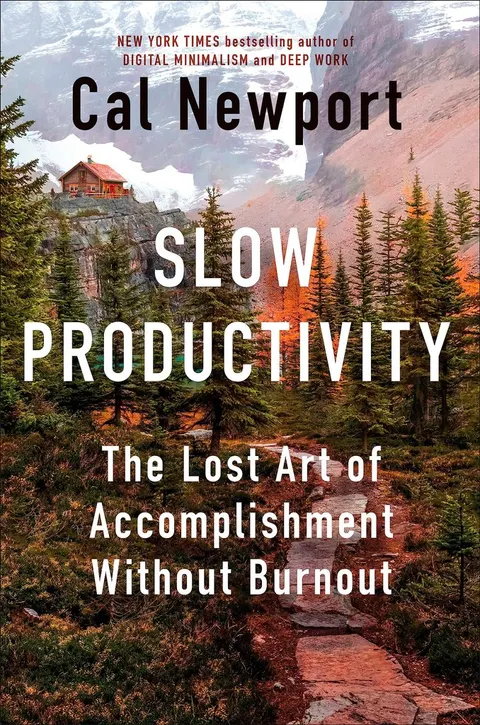
Slow Productivity
Cal Newport
113 highlights read may → oct 2024 find this book ↗
Passages
13 of 113, in reading order
-
loc. 200
None of these answers included specific goals to meet, or performance measures that could differentiate between doing a job well versus badly. When quantity was mentioned, it tended to be in the general sense that more is always better. (Productivity is “working all the time,” explained an exhausted postdoc named Soph.)
-
loc. 321
A virtual assistant named Myra provided a unique perspective, as she could summarize what she noticed about the multiple knowledge workers that she served. “My clients are very busy, but are often so overwhelmed by everything they want or have to do, that it becomes difficult to recognize what the priorities are for them,” she told me. “So they just try to work on a lot and hope they make progress that way.”
-
loc. 434
“The slow movement was first seen as an idea for a few people who liked to eat and drink well,” explained the mayor of Petrini’s hometown of Bra. “But now it has become a much broader cultural discussion about the benefits of doing things in a more human, less frenetic manner.”
-
loc. 626
PRINCIPLE #1: DO FEWER THINGS Strive to reduce your obligations to the point where you can easily imagine accomplishing them with time to spare. Leverage this reduced load to more fully embrace and advance the small number of projects that matter most.
-
loc. 898 ❦
There exists a myth that it’s hard to say no, whether to someone else or to your own ambition. The reality is that saying no isn’t so bad if you have hard evidence that it’s the only reasonable answer.
-
loc. 1047
Starting in the 1990s, however, a lot of the activity that began dominating the attention of knowledge workers like Mann wasn’t the execution of discrete tasks, but instead interactions with others about these tasks. The introduction of personal computers, followed soon after by electronic communication tools like email, transformed office collaboration into an ongoing, haphazard bazaar of asynchronous, back-and-forth messaging—a colleague asks you to handle something, you reply to clarify what he means, you then write another colleague to gather the needed information, but based on her response, you realize you don’t fully understand the task, so you send a new message to the original requester, and so on. Multiply these drawn-out interactions by dozens of concurrent open loops, and soon you’re spending most of your time managing conversations, not executing individual tasks. David Allen’s carefully organized lists don’t help the project manager who must reply to dozens of emails an hour.
-
loc. 1397
PRINCIPLE #2: WORK AT A NATURAL PACE Don’t rush your most important work. Allow it instead to unfold along a sustainable timeline, with variations in intensity, in settings conducive to brilliance.
-
loc. 1487 ❦
Then knowledge work entered the scene as a major economic sector. As discussed in part 1, the managerial class didn’t know how to handle the autonomy and variety of jobs in this new sector. Their stopgap response was pseudo-productivity, which used visible activity as a proxy for usefulness. Under this new configuration, we took another step backward. As in the industrial sector, we continued to work all day, every day, without seasonal changes, as any such variation would now be received as nonproductiveness. But unlike in the industrial sector, in this invisible factory we’d constructed for ourselves we didn’t have reform legislation or unions to identify the most draining aspects of this setup and fight for limits. Knowledge work was free to totalize our existence: colonizing as much of our time, from evenings to weekends to vacations, as we could bear, and leaving little recourse beyond burnout or demotion or quitting when it became too much.
-
loc. 1557
become comfortable taking longer on important projects.
-
loc. 1622
These strategies, of course, aren’t meant to apply to every day without exception. An idea we’ll explore later in this chapter is that working at a natural pace will still include periods of intense busyness and effort. There will be days, in other words, where you have to go from one meeting to another, again and again, because you’re trying to finalize an important deal, or get your arms around an unexpected crisis. There might also be days when every minute needs to be filled with last-minute tasks. But by thinking about these daily scheduling heuristics as a default approach to be deployed whenever possible, you ensure that unavoidable peaks in intensity will be followed by more leisurely troughs.
-
loc. 1693 ❦
“I recently heard about this idea of quiet quitting,” the narrator begins, “where, you’re not quitting your job, but quitting the idea of going above and beyond in your work.” He goes on to reject the “hustle culture” belief that your work is your life. “The reality is that it’s not,” he concludes. “And your worth as a person is not defined by your labor.”
-
loc. 2070
When Jewel’s first album, Pieces of You, was finally released in 1995, it fell flat. “Radio hated me, they hated me, vehemently hated me,” Jewel explained. “I mean, imagine Nirvana and Soundgarden, and then you hear a song like ‘You Were Meant for Me,’ and you go, ‘No.’ ” But because she didn’t cost the record label much money to support, they didn’t drop her. This allowed Jewel to focus her energy on building a fan base through touring, which she began to do at a relentless clip, taking on what she described as “a tremendous workload.” True to her plan, Jewel kept her expenses low. Instead of having a tour bus and tour manager, she traveled cheap in a rental car and performed without a band. At one point, she even signed on with a group called Earth Jam, which would provide her free transportation to her evening gigs if she agreed to participate in an environmentally themed showcase they put on for local high schools during the day.
-
loc. 2336
progress in theoretical computer science research often reduces to a game of cognitive chicken in which whoever is able to hold out longer through the mental discomfort of working through a proof element in their mind will end up with the sharper result.
A portion of what I highlighted, up to 1,000 words per book.