// shelf 2022
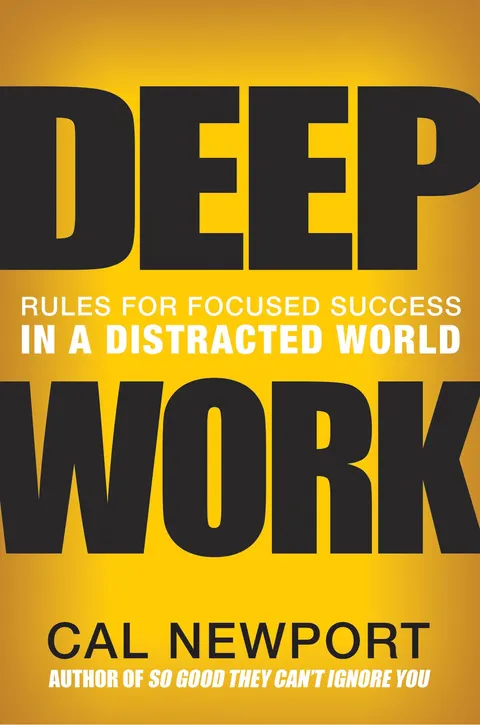
Deep Work
Cal Newport
93 highlights read aug → oct 2022 find this book ↗
Passages
15 of 93, in reading order
-
loc. 171
The Deep Work Hypothesis: The ability to perform deep work is becoming increasingly rare at exactly the same time it is becoming increasingly valuable in our economy. As a consequence, the few who cultivate this skill, and then make it the core of their working life, will thrive.
-
loc. 272
In a seminal 1981 paper, the economist Sherwin Rosen worked out the mathematics behind these “winner-take-all” markets. One of his key insights was to explicitly model talent—labeled, innocuously, with the variable q in his formulas—as a factor with “imperfect substitution,” which Rosen explains as follows: “Hearing a succession of mediocre singers does not add up to a single outstanding performance.” In other words, talent is not a commodity you can buy in bulk and combine to reach the needed levels: There’s a premium to being the best. Therefore, if you’re in a marketplace where the consumer has access to all performers, and everyone’s q value is clear, the consumer will choose the very best. Even if the talent advantage of the best is small compared to the next rung down on the skill ladder, the superstars still win the bulk of the market.
-
loc. 351
If you don’t produce, you won’t thrive—no
-
loc. 589
hour and a half per day dedicated to moving information around like a human network router.
-
loc. 706
Busyness as Proxy for Productivity: In the absence of clear indicators of what it means to be productive and valuable in their jobs, many knowledge workers turn back toward an industrial indicator of productivity: doing lots of stuff in a visible manner.
-
loc. 826
Another issue muddying the connection between depth and meaning in knowledge work is the cacophony of voices attempting to convince knowledge workers to spend more time engaged in shallow activities. As elaborated in the last chapter, we live in an era where anything Internet related is understood by default to be innovative and necessary. Depth-destroying behaviors such as immediate e-mail responses and an active social media presence are lauded, while avoidance of these trends generates suspicion. No one would fault Ric Furrer for not using Facebook, but if a knowledge worker makes this same decision, then he’s labeled an eccentric (as I’ve learned from personal experience).
-
loc. 1033
Soon
-
loc. 1136
Knuth deploys what I call the monastic philosophy of deep work scheduling. This philosophy attempts to maximize deep efforts by eliminating or radically minimizing shallow obligations. Practitioners of the monastic philosophy tend to have a well-defined and highly valued professional goal that they’re pursuing, and the bulk of their professional success comes from doing this one thing exceptionally well. It’s this clarity that helps them eliminate the thicket of shallow concerns that tend to trip up those whose value proposition in the working world is more varied.
-
loc. 1329
• How you’ll work once you start to work.
-
loc. 1481
This back-and-forth represents a collaborative form of deep work (common in academic circles) that leverages what I call the whiteboard effect. For some types of problems, working with someone else at the proverbial shared whiteboard can push you deeper than if you were working alone. The presence of the other party waiting for your next insight—be it someone physically in the same room or collaborating with you virtually—can short-circuit the natural instinct to avoid depth.
-
loc. 1600
This strategy argues that you should follow Kreider’s lead by injecting regular and substantial freedom from professional concerns into your day, providing you with the idleness paradoxically required to get (deep) work done. There are many ways to accomplish this goal. You could, for example, use Kreider’s approach of retreating from the world of shallow tasks altogether by hiding out in an “undisclosed location,” but this isn’t practical for most people. Instead, I want to suggest a more applicable but still quite powerful heuristic: At the end of the workday, shut down your consideration of work issues until the next morning—no after-dinner e-mail check, no mental replays of conversations, and no scheming about how you’ll handle an upcoming challenge; shut down work thinking completely. If you need more time, then extend your workday, but once you shut down, your mind must be left free to encounter Kreider’s buttercups, stink bugs, and stars.
-
loc. 1707 ❦
The concept of a shutdown ritual might at first seem extreme, but there’s a good reason for it: the Zeigarnik effect. This effect, which is named for the experimental work of the early-twentieth-century psychologist Bluma Zeigarnik, describes the ability of incomplete tasks to dominate our attention. It tells us that if you simply stop whatever you are doing at five p.m. and declare, “I’m done with work until tomorrow,” you’ll likely struggle to keep your mind clear of professional issues, as the many obligations left unresolved in your mind will, as in Bluma Zeigarnik’s experiments, keep battling for your attention throughout the evening (a battle that they’ll often win).
-
loc. 1763
There is, however, an important corollary to this idea: Efforts to deepen your focus will struggle if you don’t simultaneously wean your mind from a dependence on distraction. Much in the same way that athletes must take care of their bodies outside of their training sessions, you’ll struggle to achieve the deepest levels of concentration if you spend the rest of your time fleeing the slightest hint of boredom.
-
loc. 1848
If you find yourself glued to a smartphone or laptop throughout your evenings and weekends, then it’s likely that your behavior outside of work is undoing many of your attempts during the workday to rewire your brain (which makes little distinction between the two settings). In this case, I would suggest that you maintain the strategy of scheduling Internet use even after the workday is over.
-
loc. 2155
Even though the craftsman approach rejects the simplicity of the any-benefit approach, it doesn’t ignore the benefits that currently drive people to network tools, or make any advance proclamations about what’s “good” or “bad” technology: It simply asks that you give any particular network tool the same type of measured, nuanced accounting that tools in other trades have been subjected to throughout the history of skilled labor.
A portion of what I highlighted, up to 1,000 words per book.