// shelf 2024
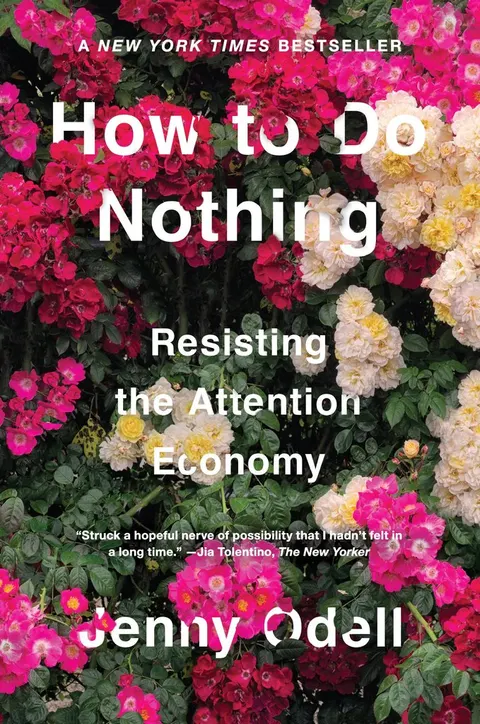
How to do nothing
Jenny Odell
154 highlights read apr 2024 find this book ↗
Passages
15 of 154, in reading order
-
loc. 265
One thing I have learned about attention is that certain forms of it are contagious. When you spend enough time with someone who pays close attention to something (if you were hanging out with me, it would be birds), you inevitably start to pay attention to some of the same things. I’ve also learned that patterns of attention—what we choose to notice and what we do not—are how we render reality for ourselves, and thus have a direct bearing on what we feel is possible at any given time. These aspects, taken together, suggest to me the revolutionary potential of taking back our attention. To capitalist logic, which thrives on myopia and dissatisfaction, there may indeed be something dangerous about something as pedestrian as doing nothing: escaping laterally toward each other, we might just find that everything we wanted is already here.
-
loc. 688 ❦
Gathering all this together, what I’m suggesting is that we take a protective stance toward ourselves, each other, and whatever is left of what makes us human—including the alliances that sustain and surprise us. I’m suggesting that we protect our spaces and our time for non-instrumental, noncommercial activity and thought, for maintenance, for care, for conviviality. And I’m suggesting that we fiercely protect our human animality against all technologies that actively ignore and disdain the body, the bodies of other beings, and the body of the landscape that we inhabit.
-
loc. 696
Certain people would like to use technology to live longer, or forever. Ironically, this desire perfectly illustrates the death drive at play in the “Manifesto of Maintenance Art” (“separation, individuality, Avant-Garde par excellence; to follow one’s own path—do your own thing; dynamic change”)30. To such people I humbly propose a far more parsimonious way to live forever: to exit the trajectory of productive time, so that a single moment might open almost to infinity. As John Muir once said, “Longest is the life that contains the largest amount of time-effacing enjoyment.”
-
loc. 1356
So to a question like “Will you or will you not participate as asked?” Diogenes would have answered something else entirely: “I will participate, but not as asked,” or, “I will stay, but I will be your gadfly.” This answer (or non-answer) is something I think of as producing what I’ll call a “third space”—an almost magical exit to another frame of reference. For someone who cannot otherwise live with the terms of her society, the third space can provide an important if unexpected harbor.
-
loc. 1881
These disjunctures and discrepancies in size undermine any sense of continuity or punctum. Without the familiar framework of a consistent vanishing point, the eye roams across the scene, dwelling in small details and trying to add it all up. This process forces us to notice our own “construction” of every scene that we perceive as living beings in a living world. In other words, the piece is a collage not so much because Hockney had an aesthetic fondness for collage, but because something like collage is at the heart of the unstable and highly personal process of perception.
-
loc. 2041
ULTIMEYES
-
loc. 2198
In effect, the opposite of a racist view is Buber’s “I-Thou” perception, which assiduously refuses to let the other collapse into any one instrumental category. Recall that Buber refuses to see the tree as image, species, or relationship of numbers. Instead “thou” has the same depth as I. Seeing this way means foregoing all of the many easier and more habitual ways to “see,” and as such, it is a fragile state requiring the discipline to continue.
-
loc. 2241
John Cage
-
loc. 2299
Nothing is so simultaneously familiar and alien as that which has been present all along.
-
loc. 2606
Kimmerer, as both an Anishinaabe woman and a classically trained scientist, allows in Braiding Sweetgrass that the right kind of scientific gaze can be part of rebuilding the relationships with land that we lost, or rather pushed out, beginning in the eighteenth century. Describing ecologists trying to bring the salmon back to a restored watershed in the Pacific Northwest, she writes that “[s]cience can be a way of forming intimacy and respect with other species that is rivaled only by the observations of traditional knowledge holders. It can be a path to kinship.”
-
loc. 2906
Veronica Barassi, in her essay “Social Media, Immediacy and the Time for Democracy,”
-
loc. 3062
Taeyoon’s strategy echoes the findings of Barassi about the incubation time of activism. Just as activism requires strategic openness and closure, forming any idea requires a combination of privacy and sharing. But this restraint is difficult when it comes to commercial social media, whose persuasive design collapses context within our very thought processes themselves by assuming we should share our thoughts right now—indeed, that we have an obligation to form our thoughts in public! Though I acknowledge that some people enjoy sharing their process publicly, this is personally anathema to me as an artist. The choice—not of what to say (“What’s on your mind?”) but whether and when to participate—doesn’t feel like it belongs to me when I use Facebook and Twitter.
-
loc. 3085 ❦
In his article on Scuttlebutt, Bogost asks, “What if isolation and disconnection could actually be desirable conditions for a computer network?” He says this in the context of describing how Dominic Tarr, the creator of Scuttlebutt, lives largely offline in a sailboat in New Zealand, but it makes me think of the not-yet-wireless phone in my house growing up. Before I got older and started carrying around a heavy black rectangle of potentiality and dread, it worked like this: You thought about the call you needed to make, you went to the phone made the call, and then you walked away. If you decided you had something more to say, you called back later. Not only that, the interaction was with the one other person you had decided to contact. Even calling someone to chat aimlessly had more intention than many of the ways I communicate now.
-
loc. 3295
American Progress by John Gast,
-
loc. 3517 ❦
The migrating birds return each year, for now anyway, and I have not yet been reduced to an algorithm.
A portion of what I highlighted, up to 1,000 words per book.