// shelf 2024
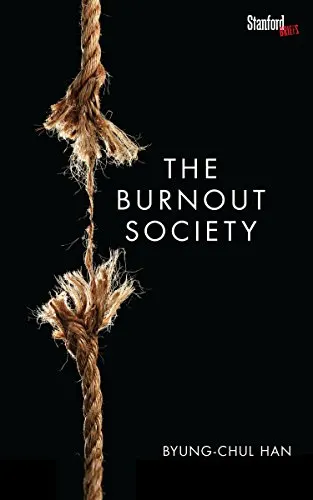
The Burnout Society
Byung-Chul Han
45 highlights read nov 2023 → may 2024 find this book ↗
Passages
13 of 45, in reading order
-
loc. 128
The violence of positivity does not deprive, it saturates; it does not exclude, it exhausts. That is why it proves inaccessible to unmediated perception.
-
loc. 148
On one level, continuity holds in the paradigm shift from disciplinary society to achievement society. Clearly, the drive to maximize production inhabits the social unconscious. Beyond a certain point of productivity, disciplinary technology—or, alternately, the negative scheme of prohibition—hits a limit. To heighten productivity, the paradigm of disciplination is replaced by the paradigm of achievement, or, in other words, by the positive scheme of Can; after a certain level of productivity obtains, the negativity of prohibition impedes further expansion. The positivity of Can is much more efficient than the negativity of Should. Therefore, the social unconscious switches from Should to Can. The achievement-subject is faster and more productive than the obedience-subject. However, the Can does not revoke the Should. The obedience-subject remains disciplined. It has now completed the disciplinary stage. Can increases the level of productivity, which is the aim of disciplinary technology, that is, the imperative of Should. Where increasing productivity is concerned, no break exists between Should and Can; continuity prevails.
-
loc. 172
Nietzsche’s sovereign man, his own man, was becoming a mass phenomenon: there was nothing above him that could tell him who he ought to be because he was the sole owner of himself.
-
loc. 193
Excessive positivity also expresses itself as an excess of stimuli, information, and impulses. It radically changes the structure and economy of attention. Perception becomes fragmented and scattered. Moreover, the mounting burden of work makes it necessary to adopt particular dispositions toward time and attention [Zeit-und Aufmerksamkeitstechnik]; this in turn affects the structure of attention and cognition.
-
loc. 198
An animal busy with eating must also attend to other tasks. For example, it must hold rivals away from its prey. It must constantly be on the lookout, lest it be eaten while eating. At the same time, it must guard its young and keep an eye on its sexual partner. In the wild, the animal is forced to divide its attention between various activities. That is why animals are incapable of contemplative immersion—either they are eating or they are copulating. The animal cannot immerse itself contemplatively in what it is facing [Gegenüber] because it must also process background events.
-
loc. 217
The “gift of listening” is based on the ability to grant deep, contemplative attention—which remains inaccessible to the hyperactive ego.
-
loc. 273
Arendt’s descriptions of the modern animal laborans do not correspond to what we can observe in today’s achievement society. The late-modern animal laborans does not give up its individuality or ego in order to merge, through the work it performs, with the anonymous life process of the species. Rather, contemporary labor society, as a society of achievement and business, fosters individuality
-
loc. 299
The acceleration of contemporary life also plays a role in this lack of being. The society of laboring and achievement is not a free society. It generates new constraints. Ultimately, the dialectic of master and slave does not yield a society where everyone is free and capable of leisure, too. Rather, it leads to a society of work in which the master himself has become a laboring slave. In this society of compulsion, everyone carries a work camp inside. This labor camp is defined by the fact that one is simultaneously prisoner and guard, victim and perpetrator. One exploits oneself. It means that exploitation is possible even without domination.
-
loc. 322
Not the active life but the contemplative life makes man into what he should be. Arendt changes the same words into praise for the vita activa. What is more, the solitary contemplation Cato speaks of proves incompatible with the “power of acting human beings,” which Arendt invokes time and again. Toward the end of her discussion of vita activa, then, Arendt inadvertently endorses vita contemplativa. It escapes her notice that the loss of the ability to contemplate—which, among other things, leads to the absolutization of vita activa—is also responsible for the hysteria and nervousness of modern society.
-
loc. 336
The vita contemplativa is not a matter of passive affirmation and being open to whatever happens. Instead, it offers resistance to crowding, intrusive stimuli. Instead of surrendering the gaze to external impulses, it steers them in sovereign fashion. As a mode of saying no, sovereign action [Tun] proves more active than any and all hyperactivity, which represents a symptom of mental exhaustion. What eludes Arendt in the dialectic of being-active [Aktivsein] is that hyperactive intensification leads to an abrupt switch into hyperpassivity; now one obeys every impulse or stimulus without resistance. Instead of freedom, it produces new constraints. It is an illusion to believe that being more active means being freer.
-
loc. 488
Tiredness of this kind proves violent because it destroys all that is common or shared, all proximity, and even language itself: “Doomed to remain speechless, that sort of tiredness drove us to violence. A violence that may have expressed itself only in our manner of seeing, which distorted the other” (9).
-
loc. 708 ❦
Ehrenberg considers depression exclusively in terms of psychology and the pathology of the self. In so doing, he fails to consider economic context. Burnout, which often precedes depression, does not point to a sovereign individual who has come to lack the power to be the “master of himself.” Rather, burnout represents the pathological consequence of voluntary self-exploitation. The imperative of expansion, transformation, and self-reinvention—of which depression is the flipside—presumes an array of products tied to identity. The more often one changes one’s identity, the more production is dynamized. Industrial disciplinary society relied on unchanging identity, whereas postindustrial achievement society requires a flexible person to heighten production.
-
loc. 724
Deficit filled, apathy stimulated, impulses regulated, compulsion tamed—all of this has made dependency the flipside of depression. With the gospel of personal development on the one hand and the cult of performance on the other, conflict does not disappear; however, it loses its obvious quality and can no longer be counted on to guide us.20
A portion of what I highlighted, up to 1,000 words per book.