// shelf 2023
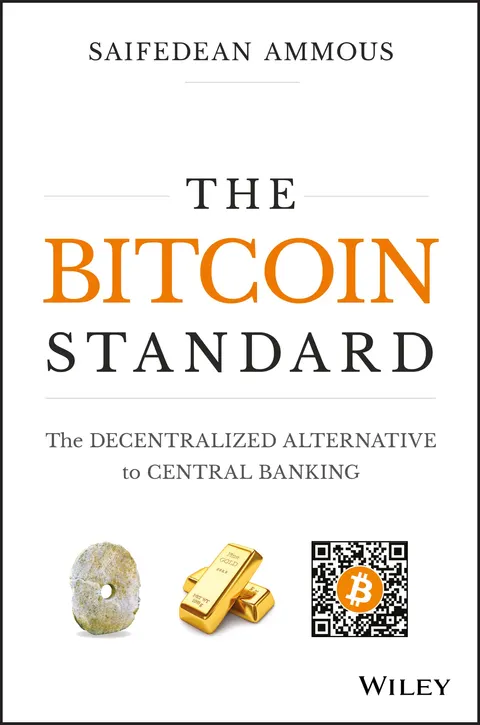
The Bitcoin Standard
Saifedean Ammous
127 highlights read mar → aug 2023 find this book ↗
Passages
14 of 127, in reading order
-
loc. 69 ❦
Sound money allows people to think about the long term and to save and invest more for the future. Saving and investing for the long run are the key to capital accumulation and the advance of human civilization. Money is the information and measurement system of an economy, and sound money is what allows trade, investment, and entrepreneurship to proceed on a solid basis, whereas unsound money throws these processes into disarray.
-
loc. 97 ❦
Bitcoin is the newest technology to serve the function of money—an invention leveraging the technological possibilities of the digital age to solve a problem that has persisted for all of humanity's existence: how to move economic value across time and space.
-
loc. 396
The gold standard allowed for unprecedented global capital accumulation and trade by uniting the majority of the planet's economy on one sound market‐based choice of money. Its tragic flaw, however, was that by centralizing the gold in the vaults of banks, and later central banks, it made it possible for banks and governments to increase the supply of money beyond the quantity of gold they held, devaluing the money and transferring part of its value from the money's legitimate holders to the governments and banks.
-
loc. 433 ❦
For anything to function as a good store of value, it has to beat this trap: it has to appreciate when people demand it as a store of value, but its producers have to be constrained from inflating the supply significantly enough to bring the price down.
-
loc. 794
The common name for government money is fiat money, from the Latin word for decree, order, or authorization.
-
loc. 1130
This move by President Nixon completed the process begun with World War I, transforming the world economy from a global gold standard to a standard based on several government‐issued currencies. For a world that was growing increasingly globalized along with advancements in transportation and telecommunications, freely fluctuating exchange rates constituted what Hoppe termed “a system of partial barter.”13 Buying things from people who lived on the other side of imaginary lines in the sand now required utilizing more than one medium of exchange and reignited the age‐old problem of lack of coincidence of wants. The seller does not want the currency held by the buyer, and so the buyer must purchase another currency first, and incur conversion costs.
-
loc. 1415 ❦
Animals' time preference is far higher than humans', as they act to the satisfaction of their immediate instinctive impulses and have little conception of the future. A few animals are capable of building nests or homes that can last for the future, and these have a lower time preference than the animals that act to the satisfaction of their immediate needs such as hunger and aggression. Human beings' lower time preference allows us to curb our instinctive and animalistic impulses, think of what is better for our future, and act rationally rather than impulsively. Instead of spending all our time producing goods for immediate consumption, we can choose to spend time engaged in production of goods that will take longer to complete, if they are superior goods. As humans reduce their time preference, they develop the scope for carrying out tasks over longer time horizons, for satisfaction of ever‐more remote needs, and they develop the mental capacity to create goods not for immediate consumption but for the production of future goods, in other words, to create capital goods.
-
loc. 1426 ❦
This is the essence of investment: as humans delay immediate gratification, they invest their time and resources in the production of capital goods which will make production more sophisticated or technologically advanced and extend it over a longer time‐horizon.
-
loc. 1482
The sobering reality to keep in mind is that a man's lot in life will be largely determined by these trades between him and his future self.
-
loc. 1493 ❦
A society in which individuals bequeath their children more than what they received from their parents is a civilized society: it is a place where life is improving, and people live with a purpose of making the next generation's lives better. As society's capital levels continue to increase, productivity increases and, along with it, quality of life. The security of their basic needs assured, and the dangers of the environment averted, people turn their attention toward more profound aspects of life than material well‐being and the drudgery of work. They cultivate families and social ties; undertake cultural, artistic, and literary projects; and seek to offer lasting contributions to their community and the world. Civilization is not about more capital accumulation per se; rather, it is about what capital accumulation allows humans to achieve, the flourishing and freedom to seek higher meaning in life when their base needs are met and most pressing dangers averted.
-
loc. 2057
“Those who confuse entrepreneurship and management close their eyes to the economic problem…. The capitalist system is not a managerial system; it is an entrepreneurial system.”
-
loc. 2474
“[G]overnments believe that … when there is a choice between an unpopular tax and a very popular expenditure, there is a way out for them—the way toward inflation. This illustrates the problem of going away from the gold standard.”
-
loc. 3112
Any form of electronic payment had to be carried out via an intermediary because of the danger of double‐spending: there was no way of guaranteeing that the payer was being honest with his funds, and not using them more than once, unless there was a trusted third party overseeing the account and able to verify the integrity of the payments carried out. Cash transactions were confined to the physical realm of direct contact, while all digital forms of payments had to be supervised by a third party.
-
loc. 4035
PoW makes the cost of writing a block extremely high and the cost of verifying its validity extremely low, almost eliminating the incentive for anyone to try to create invalid transactions. If they tried, they would be wasting electricity and processing power without receiving the block reward. Bitcoin can thus be understood as a technology that converts electricity to truthful records through the expenditure of processing power.
A portion of what I highlighted, up to 1,000 words per book.